Bikram Sambat vs AD Dates for Business Records in Nepal
By Aryan Pariyar7 min read
Quick answer
Use Bikram Sambat (BS) for anything the Inland Revenue Department sees, such as VAT returns, income tax and the fiscal year, because Nepal's tax calendar runs on BS. Use AD for anything Meta sees, such as ad spend, receipts and campaign dates, because Facebook bills and reports in AD. The safe setup is to store one real date per record and view it in either calendar.
Bikram Sambat business accounting: the short answer
For bikram sambat business accounting in Nepal, the rule is simple: tax deadlines are in BS, and Facebook ad data is in AD. Nepal's fiscal year runs from Shrawan 1 to the end of Asar, so fiscal year 2083/84 started on 17 July 2026 and ends around mid-July 2027.
Meta, on the other hand, has no idea what Bhadra or Ashoj is. Ads Manager reports spend by AD date, in your ad account's time zone. If you run ads for clients, you live in both calendars every day.
You don't have to pick one. You need a system where each transaction has one real date, and you can switch the view between BS and AD without retyping anything.
Where BS dates are required
The Inland Revenue Department (IRD) works on the Bikram Sambat calendar. These are the dates a freelancer or small agency should track in BS:
- VAT returns: if you are VAT-registered, monthly returns and payment are due by the 25th of the following Nepali month.
- Income tax return: due within 3 months of the end of the income year (the year ends at Asar end). IRD can extend this by up to 3 more months on written request.
- Advance (estimated) tax: instalments of 40% by Poush end, 70% by Chaitra end and 100% by Asar end. Late advance tax attracts interest of 15% a year under section 118.
- Local invoices and PAN/VAT bills: clients and their accountants usually expect BS dates on bills.
Why the two calendars don't line up neatly
BS months are not fixed at 30 or 31 days. They run from 29 to 32 days, and the length of a month can change from year to year. The Nepal Panchanga Nirnayak Samiti (calendar committee) decides them.
That means a BS month never maps cleanly to an AD month. Shrawan starts in mid-July and ends in mid-August. So Meta's 'August' spend is split across Shrawan and Bhadra.
This matters when you report profit. If you total a client's spend for 'Bhadra' using an AD month filter, you will be wrong by two weeks.
A practical setup for freelancers and agencies
You don't need a second set of books. You need one date per record and a converter you trust. Here is a setup that works:
- Store every transaction with a single date (internally AD is easiest, because software and Meta use it).
- Set every client ad account to the Kathmandu time zone, so a Meta day equals a Nepal day.
- Show dates in BS on client bills, payment receipts and anything your accountant files.
- When you report by month for tax, filter by BS month boundaries, not AD month boundaries.
- Keep a running list of BS tax deadlines (VAT 25th, Poush, Chaitra and Asar ends) in your calendar.
- At fiscal year end (Asar end), export a BS-dated report of income and costs for your auditor.
How spreadsheets and apps handle BS dates
Google Sheets and Excel do not understand BS dates natively. If you type 2083-06-21 into a date cell, the sheet treats it as a far-future AD date. Sorting may still work, but date math, month filters and charts will be wrong.
Many people keep BS dates as plain text and add an AD column next to it. That works, but it doubles the typing and the two columns drift apart when someone edits one and forgets the other.
Open-source libraries convert BS to AD accurately for the range they cover (one popular JavaScript library covers 1975 to 2099 BS), so any app built for Nepal can show both from one stored date.
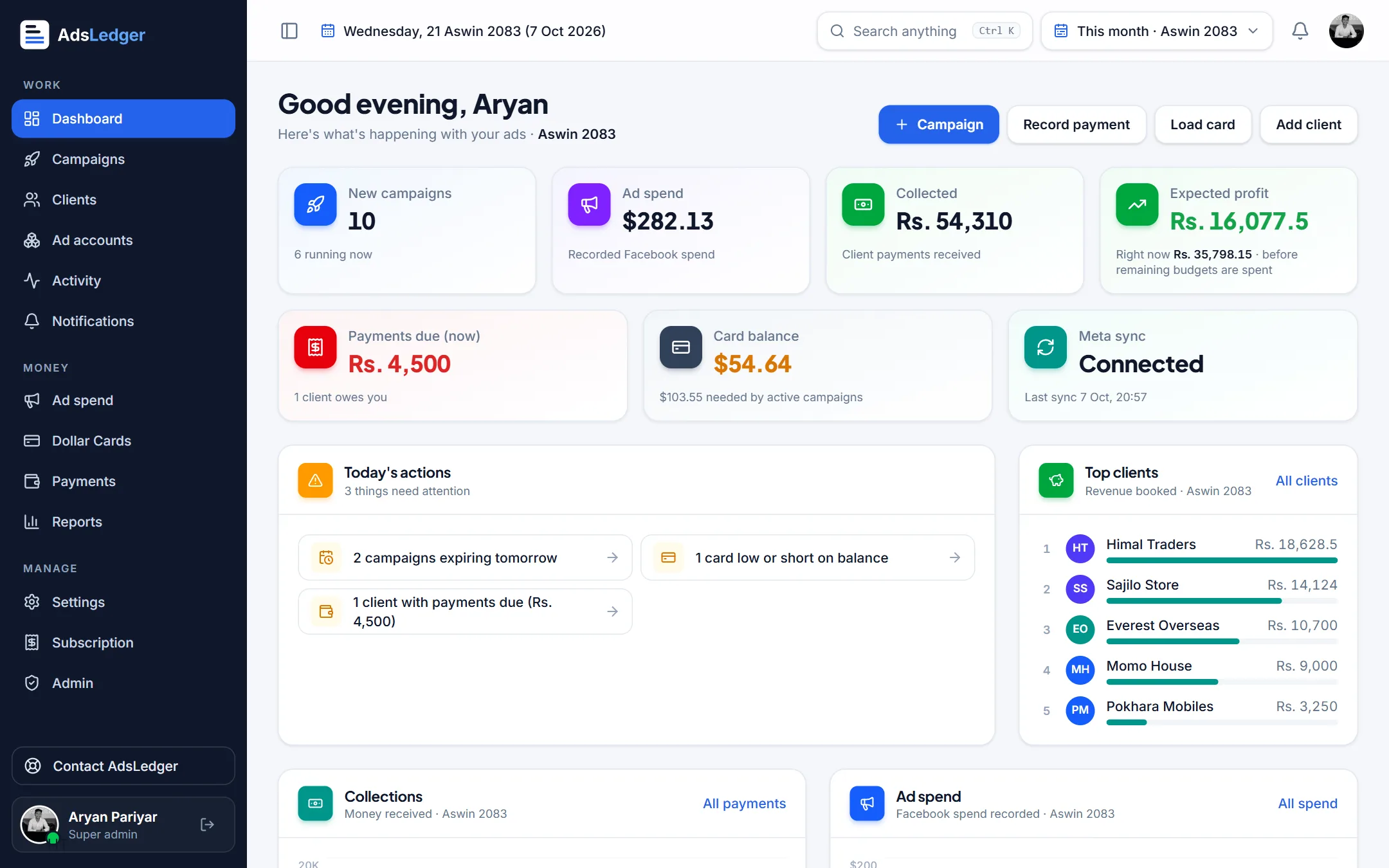
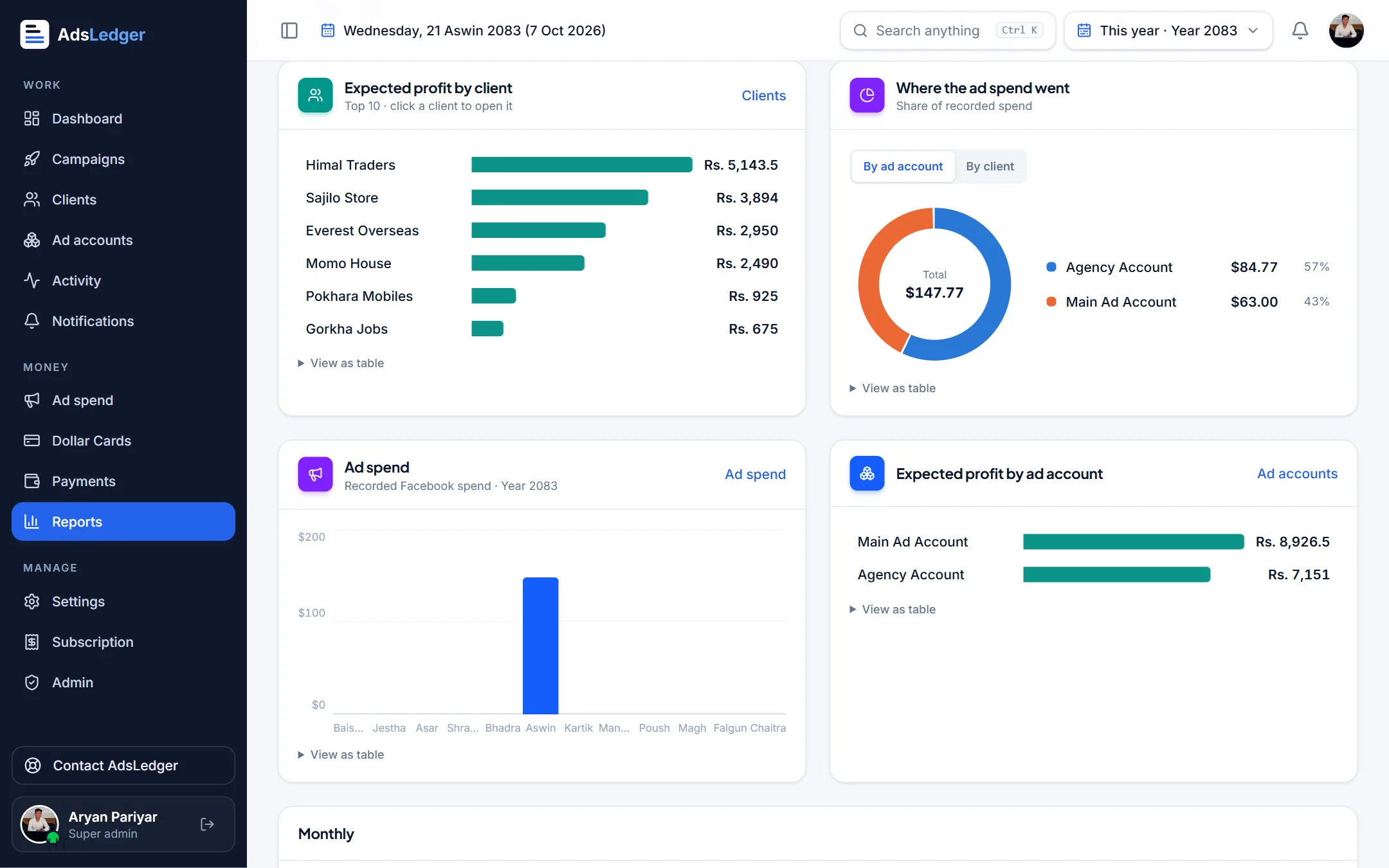
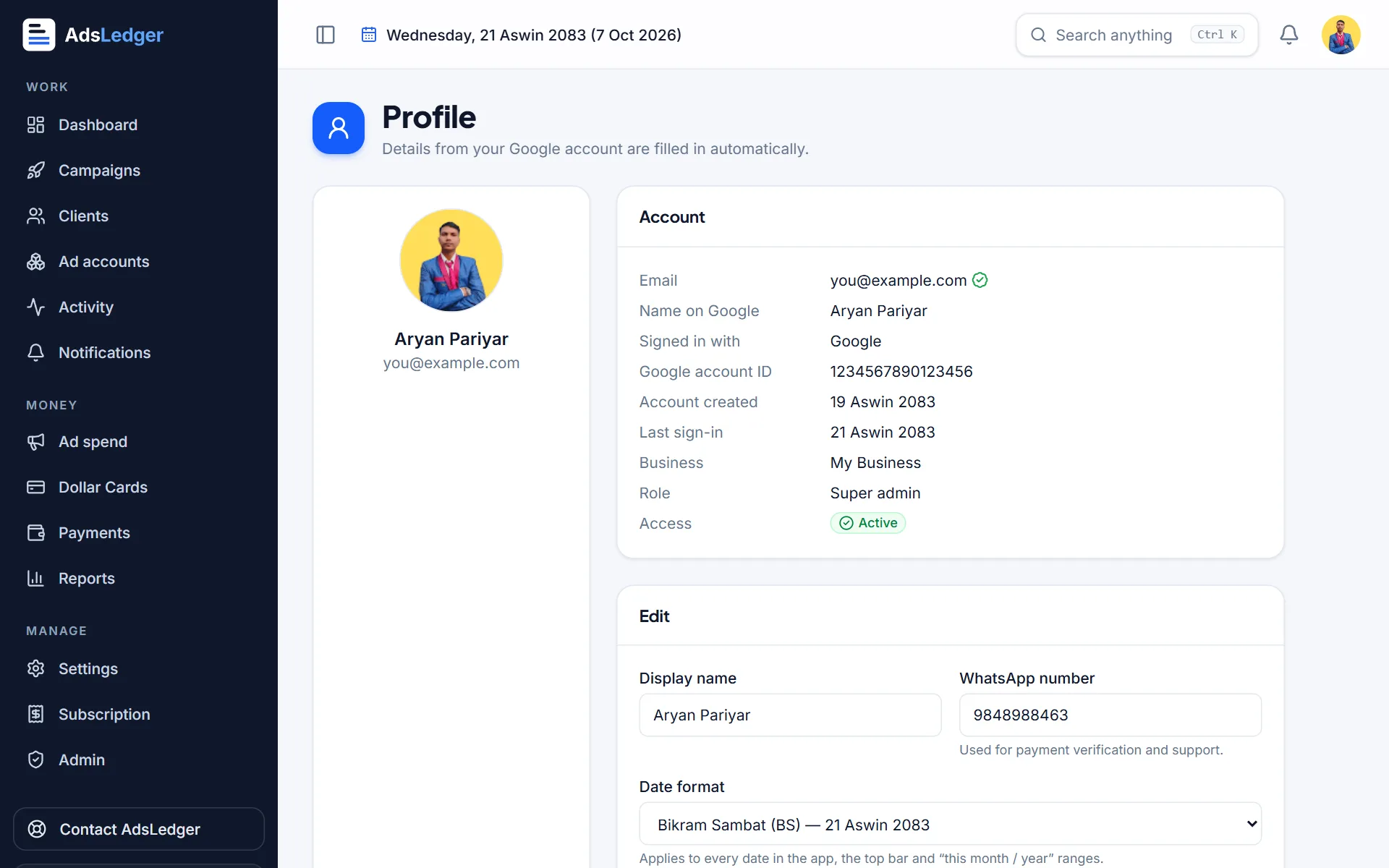
In AdsLedger, you choose Bikram Sambat or AD in your profile, and dates across campaigns, payments and reports switch with it. Meta spend keeps its real AD date underneath, so nothing is retyped.
Common mistakes to avoid
None of these are hard to fix, but they all cost time at the worst moment: tax season or a client dispute.
- Converting dates by hand with a fixed offset like 'add 56 years and 8 months'. Month lengths vary, so this drifts by days.
- Reporting a BS month using AD month filters.
- Leaving client ad accounts on Pacific time and then wondering why daily spend never matches.
- Writing AD dates on a local PAN or VAT bill when the client's accountant expects BS.
- Waiting until Asar to sort out dates. Fix the system in Shrawan, at the start of the fiscal year.
Frequently asked questions
Do I have to use Bikram Sambat dates for business accounting in Nepal?
Nepal's tax system, including the fiscal year and VAT and income tax deadlines, runs on Bikram Sambat. You can keep internal records in AD, but what you file with IRD and the deadlines you follow are in BS. Ask your auditor how they want your books presented.
When does Nepal's fiscal year start and end?
It runs from Shrawan 1 to the end of Asar. Fiscal year 2083/84 began on 17 July 2026 and ends around mid-July 2027.
Why doesn't my Facebook daily spend match my Nepal dates?
Meta reports by the ad account's time zone, and new accounts default to Pacific time. If the account isn't set to Kathmandu time, a Meta 'day' cuts across two Nepal days. Changing the time zone creates a new ad account, so set it correctly at the start.
Can Google Sheets handle Bikram Sambat dates?
Not natively. Sheets treats dates as Gregorian, so BS dates must be stored as text or converted with a script or add-on. Many people keep a BS text column next to an AD date column.
Sources
- Nepal VAT Guide for 2026: Rates, Registration & Compliance (Kintsugi)
- VAT in Nepal: Rates and Thresholds 2082/83 (Law Alpine)
- 5 Nepal Tax Facts Entrepreneurs Should Know (NBSM)
- Inland Revenue Department, Nepal
- Change the time zone for your ad account (Meta Business Help Center)
- Nepali Date Converter library README
- Nepal's Calendar: Why Is It 2081 Already?
Fees, limits and rules change — always confirm with your bank, Meta or the Inland Revenue Department. Examples are illustrations, not quotes.