Facebook Boost Price in Nepal (2026): What to Charge Clients
By Aryan Pariyar7 min read
Quick answer
The Facebook boost price in Nepal is usually quoted per dollar of ad spend: publicly advertised rates in 2026 sit around Rs. 177–180 per USD, or the exchange rate plus about 20%. Agencies that also manage the page charge a separate monthly fee, commonly Rs. 8,000–40,000. Your own price should start from what one dollar really costs you, then add a margin you can defend.
Facebook boost price in Nepal: the short answer
The facebook boost price in nepal is almost always quoted as a rupee rate per US dollar that goes to Meta. In 2026, boosting services publicly advertise rates around Rs. 177 to Rs. 180 per dollar, and some say they charge the day's exchange rate plus a flat 20% service charge. Clients usually pay in rupees by eSewa, Khalti or bank transfer, and the boosting operator pays Meta with a dollar card.
That rate sits on top of an official exchange rate of roughly Rs. 152–153 per dollar (Nepal Rastra Bank selling rate in August 2026). The gap between the two is the operator's gross margin before card fees, top-up charges and their own time.
This guide shows what is publicly advertised, how the pricing models differ, and how to work out a price that still leaves profit after costs.
What Nepali boosting services advertise in 2026
Prices vary a lot between operators, and many only share rates on WhatsApp. These are rates that were publicly listed on websites when we checked in October 2026. Treat them as a snapshot, not a fixed market price.
- Prime IT Sewa: lists a 'Facebook Boosting Dollar Charge' of Rs. 177, and separate campaign packages starting from NPR 2,500 (small business, page likes) up to NPR 10,000 (branding).
- Plus Point Solution: advertises Rs. 180 per dollar with a minimum of $2.
- AD Boosting in Nepal: says on its Facebook page that it charges a flat 20% service charge with no hidden fees.
- ACT360 Ads Manager app: shows a cost breakdown of ad spend plus TDS 15%, bank charge 3.5%, service charge 15% and VAT 13%, with a minimum boost of $5 for up to 5 days.
- Nxtech: quotes management from NPR 8,000 per month on top of the ad budget, and suggests a starter daily budget of NPR 1,000–2,000.
The three pricing models you will see
Most operators in Nepal use one of three models, or mix them. Knowing which one you are using makes it easier to explain your price to clients.
- Per-dollar rate: the client pays a fixed rupee amount for every dollar spent, for example Rs. 180 x $10 = Rs. 1,800. Simple, popular with shops and individual sellers.
- Exchange rate plus a percentage: the client pays the day's rate plus a service charge, for example 20%. Fair when the rupee moves a lot, but harder for clients to compare.
- Monthly management fee plus ad spend: agencies charge a flat fee for strategy, design and reporting, and the ad spend is billed separately. Market guides list NPR 10,000–40,000 per month for small and growing businesses; one Kathmandu agency publishes Rs. 20,000 (Starter) and Rs. 38,000 (Growth) per month.
Start from your real cost per dollar
Before you pick a selling rate, work out your cost rate: how many rupees one dollar on your card actually cost you. This is not the NRB rate. It is the bank's selling rate on the day you loaded the card, plus any top-up fee, plus any fee the card charges on foreign transactions.
Card fees differ by bank. Global IME Bank, for example, lists NPR 500 for a virtual dollar card, NPR 100 for a top-up at a branch (free through mobile banking) and NPR 300 renewal. Other banks have their own schedule of charges, so check yours.
- Add up everything you paid in rupees for one card load, including fees.
- Divide by the dollars that actually landed on the card.
- Use that number as your cost rate until the next load.
Turn your cost into a client price
Once you know your cost rate, the selling rate is cost plus margin. The margin has to cover your time, design work, failed payments, refunds and the risk of the rupee moving before your next load.
Using the example cost of Rs. 154.50, a selling rate of Rs. 177 gives about Rs. 22.50 per dollar, roughly 14.6% gross. At Rs. 180 it is about Rs. 25.50, roughly 16.5%. Those are example numbers only; your margin depends on your own cost rate.
Many operators also set a minimum order (for example $2 or Rs. 1,000) so that very small boosts are still worth the time spent setting them up and replying to the client.
Remember the yearly limit too. The standard prepaid dollar card limit set by Nepal Rastra Bank is USD 500 per year, so a margin of Rs. 25 per dollar on a full year's standard limit is only about Rs. 12,500 of gross profit. Operators who want to grow either qualify for a higher limit (some banks allow up to USD 5,000 more for people with foreign currency income) or move clients to monthly management fees, where the profit does not depend only on dollars spent.
Finally, check your price against the result the client gets. If a Rs. 1,800 boost brings a shop 30 serious messages, the client rarely argues about Rs. 5 per dollar. If results are poor, a lower rate will not keep them.
What to include in the price (and what to charge extra for)
Be clear about what one boost includes. Clients compare your Rs. 180 to someone else's Rs. 170 without seeing that one includes a poster design and the other does not.
Writing this down once and sending it with every quote saves a lot of back-and-forth on WhatsApp. It also makes it easier to raise your price later, because clients can see what they are paying for.
- Usually included: campaign setup, audience and location, budget and duration, a short results update at the end.
- Often extra: poster or video design, writing ad copy, Page setup, replying to messages for the client, monthly reports.
- Spell out: what happens if the client wants to stop early. A fair rule is to bill only what was actually spent and keep the rest as credit for the next campaign.
Keep the price honest with simple records
The fastest way to lose money in boosting is to forget a card fee, a currency move or an unpaid balance. Record every card load with its rupee cost, every campaign with its billing rate, and every payment the client makes.
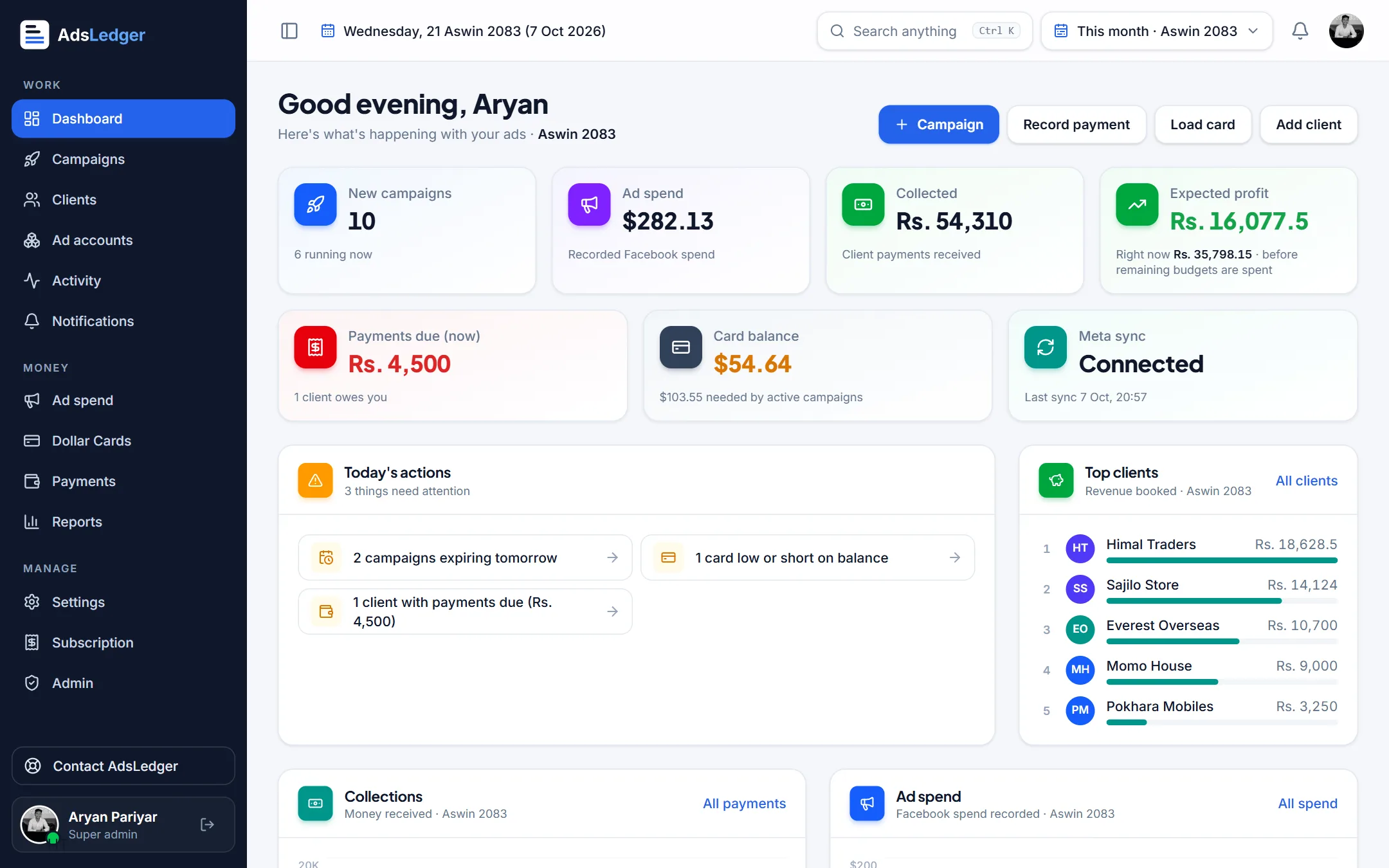
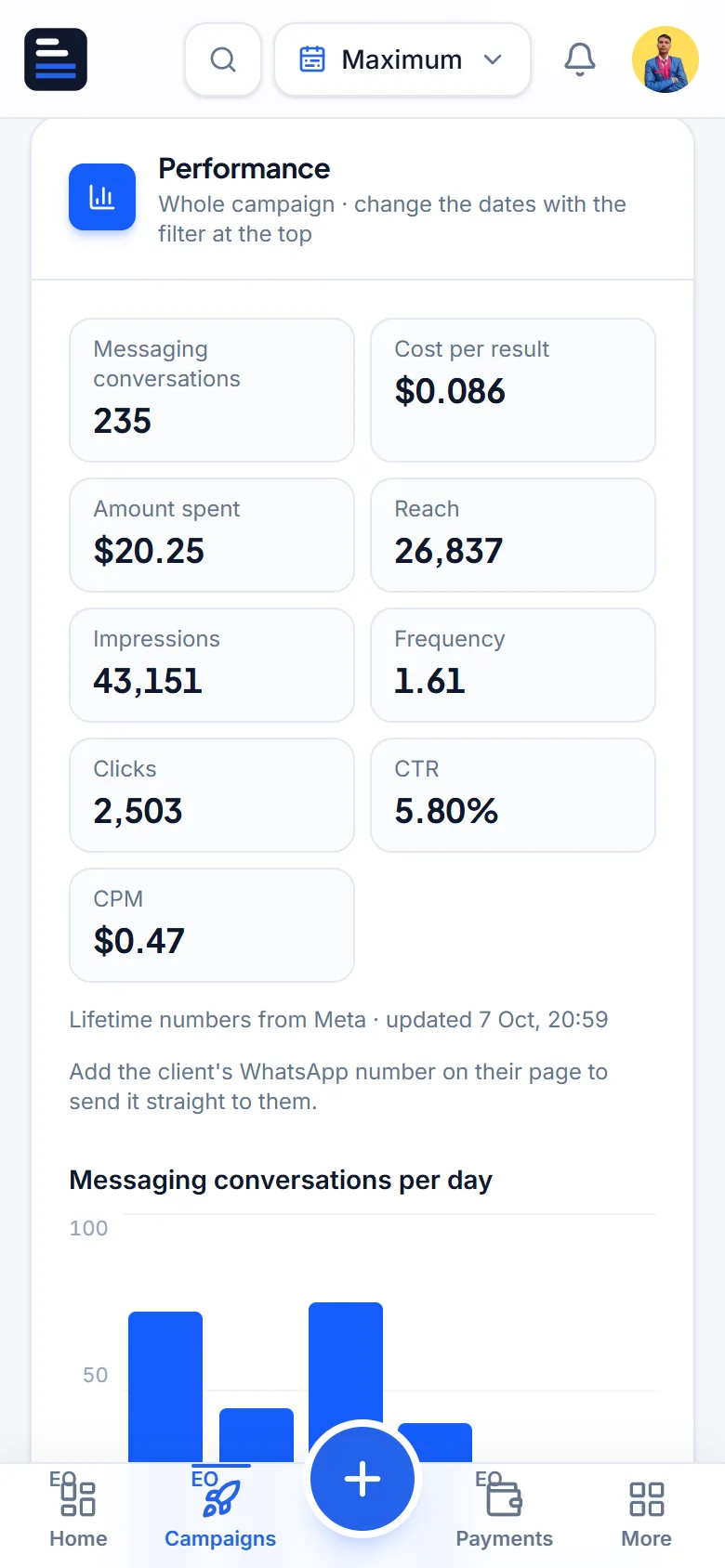
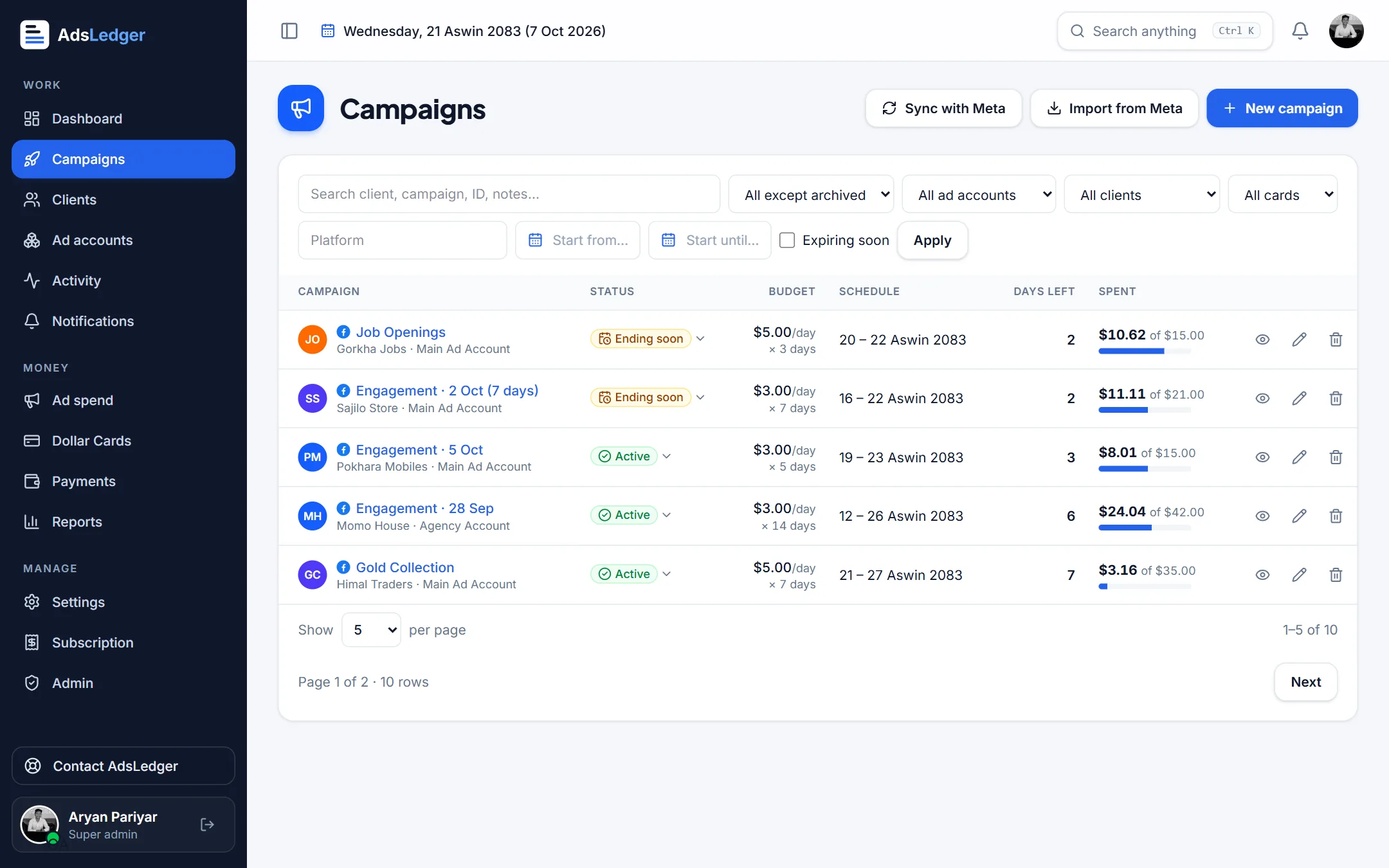
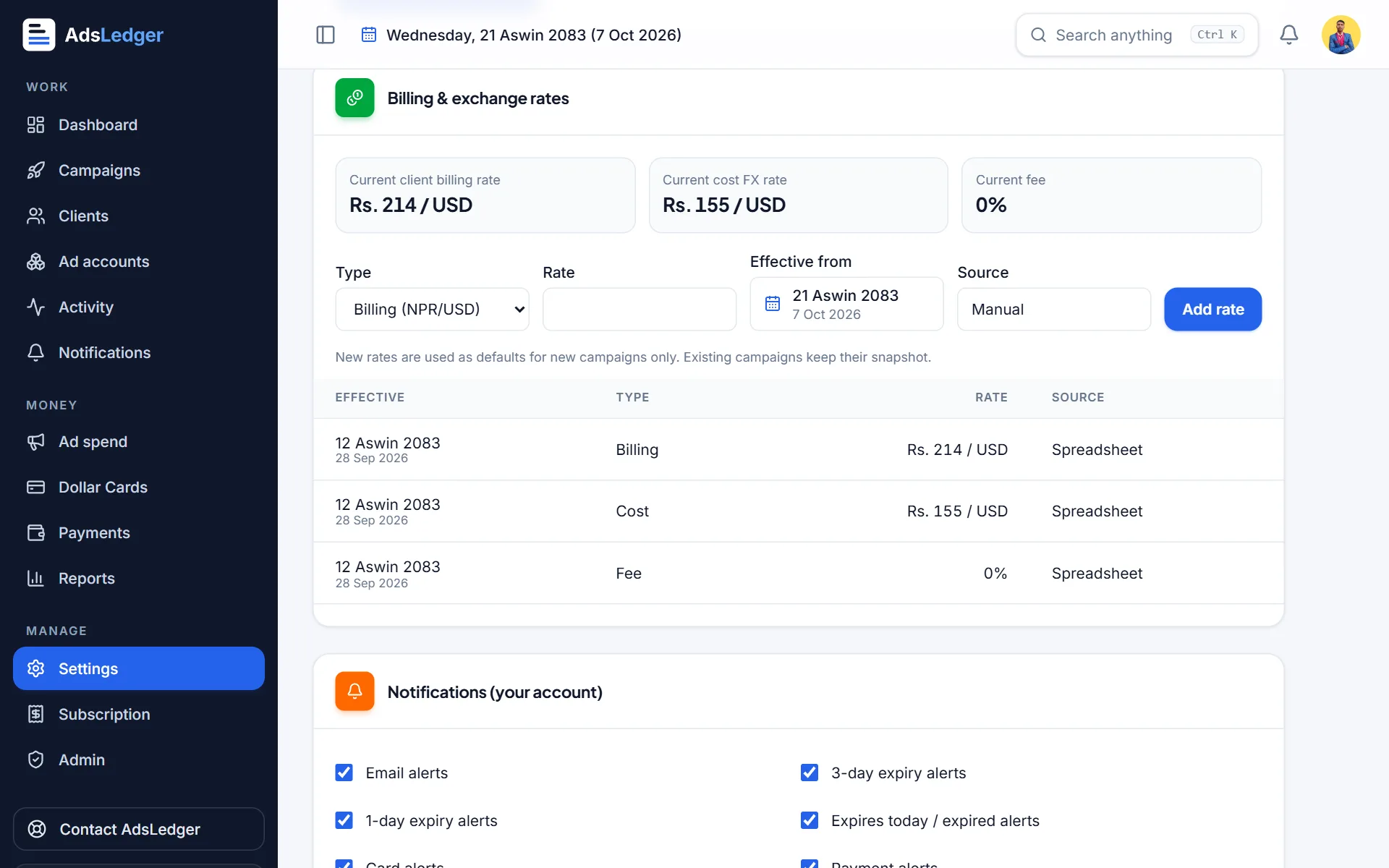
If you prefer not to do this in a spreadsheet, AdsLedger keeps a cost rate and billing rate for you, calculates the client charge and expected profit for each campaign, and tracks dues and partial payments. The exchange rate tutorial shows how to set both rates.
Frequently asked questions
What is the Facebook boost rate per dollar in Nepal?
Publicly advertised rates in 2026 are around Rs. 177–180 per US dollar, and some services charge the exchange rate plus about 20%. Rates change with the NRB exchange rate and differ between operators, so check the date on any price list.
What is the minimum budget to boost a Facebook post in Nepal?
Meta lets you run very small budgets, and Nepali guides suggest starting with $1–5 per day. Operators often set their own minimum order, for example $2 or $5, so the setup time is worth it.
Why do boosting services charge more than the exchange rate?
The operator pays for the dollar card, top-up and transaction fees, takes the risk of the rupee moving, and spends time setting up and reporting on the campaign. The extra rupees per dollar cover those costs and their profit.
Should I charge a per-dollar rate or a monthly fee?
A per-dollar rate suits one-off boosts for shops and individuals. A monthly fee plus ad spend suits ongoing clients who need design, strategy and reports. Many operators use both.
Sources
- Facebook Boost in Nepal - Prime IT Sewa
- Facebook Boost Nepal - Prime IT Sewa (package prices)
- Social Media Boosting in Nepal - Plus Point Solution
- AD Boosting in Nepal (Facebook Page)
- FAQs - ACT360 Ads Manager
- Facebook Ads Advertising and Facebook Page Boost in Nepal - Nxtech
- Facebook Marketing Agency in Nepal - Queens Digital Agency
- Meta Ads Package Nepal: What's Included, Pricing Models - MPG Solution
- The value of the US dollar has remained stable for a week straight - Ekantipur
- Boost Facebook Posts Easily in Nepal with Dollar Card - Global IME Bank
- NRB's Notice on Issuance of Prepaid Cards for Payment in Foreign Exchange - Pradhan & Associates
Fees, limits and rules change — always confirm with your bank, Meta or the Inland Revenue Department. Examples are illustrations, not quotes.