How to Start a Facebook Boosting Business in Nepal
By Aryan Pariyar7 min read
Quick answer
To start a Facebook boosting business in Nepal you need a bank-issued dollar card to pay Meta, a Meta Business account, a clear rupee rate per dollar, and a simple way to track every client's spend and payment. Most operators start with a few local shops, charge per dollar, and grow into monthly packages. Keep records from day one so you know your real profit.
Facebook boosting business Nepal: what it actually is
A facebook boosting business nepal operators run is simple at its core: local businesses want ads on Facebook and Instagram, but most cannot pay Meta in dollars. You pay Meta with your dollar card, run the ad for them, and collect rupees from the client by eSewa, Khalti or bank transfer.
The demand is real. NapoleonCat estimates about 17.8 million Facebook users in Nepal in September 2026, around 55% of the population. Shops, restaurants, clothing pages, consultancies and training institutes all advertise to that audience.
The work is part payments, part marketing, part customer service. This guide walks through each part in the order you will need it.
Step 1: Get a way to pay Meta in dollars
Nepal Rastra Bank allows commercial and development banks to issue prepaid dollar cards for online payments abroad. The standard limit is USD 500 per year per person. Some banks note that if you earn foreign currency income, an additional load of up to USD 5,000 may be allowed. Check the exact rule and documents with your bank.
Fees vary by bank. Global IME Bank, for example, lists NPR 500 for a virtual card, NPR 100 per branch top-up (free through mobile banking) and NPR 300 renewal. Ask your bank for its schedule of charges before you open a card.
- Open a prepaid dollar card with your bank (virtual cards are usually fastest).
- Load a small amount first, for example $20, to test it on Meta.
- Add the card under Billing in Meta Business settings for your ad account.
- Note the rupees you paid for each load, including fees. This becomes your cost rate.
Step 2: Set up Meta Business properly
Create a Meta Business portfolio (Business Manager) in your own name or your company's name. Ask each client to add your business as a partner on their Facebook Page instead of handing over their password. This protects both of you and makes it easy to stop working together later.
Use one ad account per client where you can. Separate ad accounts make billing, results and disputes much easier to handle.
Keep your own business portfolio tidy from the start. Name ad accounts after the client, set the time zone to Nepal and the currency to USD, and turn on two-factor authentication for every admin. A disabled or hacked account can stop all your clients' ads at once, so do not share logins and remove people who no longer work with you.
Step 3: Decide your rate and rules
Most new operators charge a rupee rate per dollar. Rates publicly advertised in 2026 are around Rs. 177–180 per dollar, while the NRB selling rate was about Rs. 152.84 in August 2026. Your price should start from your own cost per dollar, not from a competitor's poster.
Write down your rules before the first client asks: minimum order, whether design is included, what happens if a campaign stops early, and when payment is due. A common fair rule is: bill only what was actually spent, and keep any remainder as credit.
Step 4: Find your first five clients
Start close to home. Shops you already buy from, friends who sell online, and local businesses with active Pages but no ads are the easiest first clients. Offer a small trial boost with a clear goal, such as more messages, and share the results honestly.
Show real screenshots of results (with permission), reply fast, and keep promises small. Repeat clients matter more than one large campaign.
Your own Facebook Page is also your shop window. Post your rate, how clients can pay, and screenshots of real results. Then run a small ad for your own service in your city; it shows prospects you can do for yourself what you promise to do for them.
Step 5: Run campaigns that get results
Boosting from the Page is quick, but Ads Manager gives you more control over objectives, placements and testing. For most Nepali small businesses, a messages objective with a tight location and a clear offer is a good starting point.
Agree on the goal with the client before you spend: messages, calls, store visits or page followers. Measure that one thing and report it.
Before you press publish, confirm three things with the client in writing: the daily budget in dollars, the number of days, and the total in rupees. That one message prevents most disputes later, especially when a campaign is extended or stopped early.
Step 6: Track money from day one
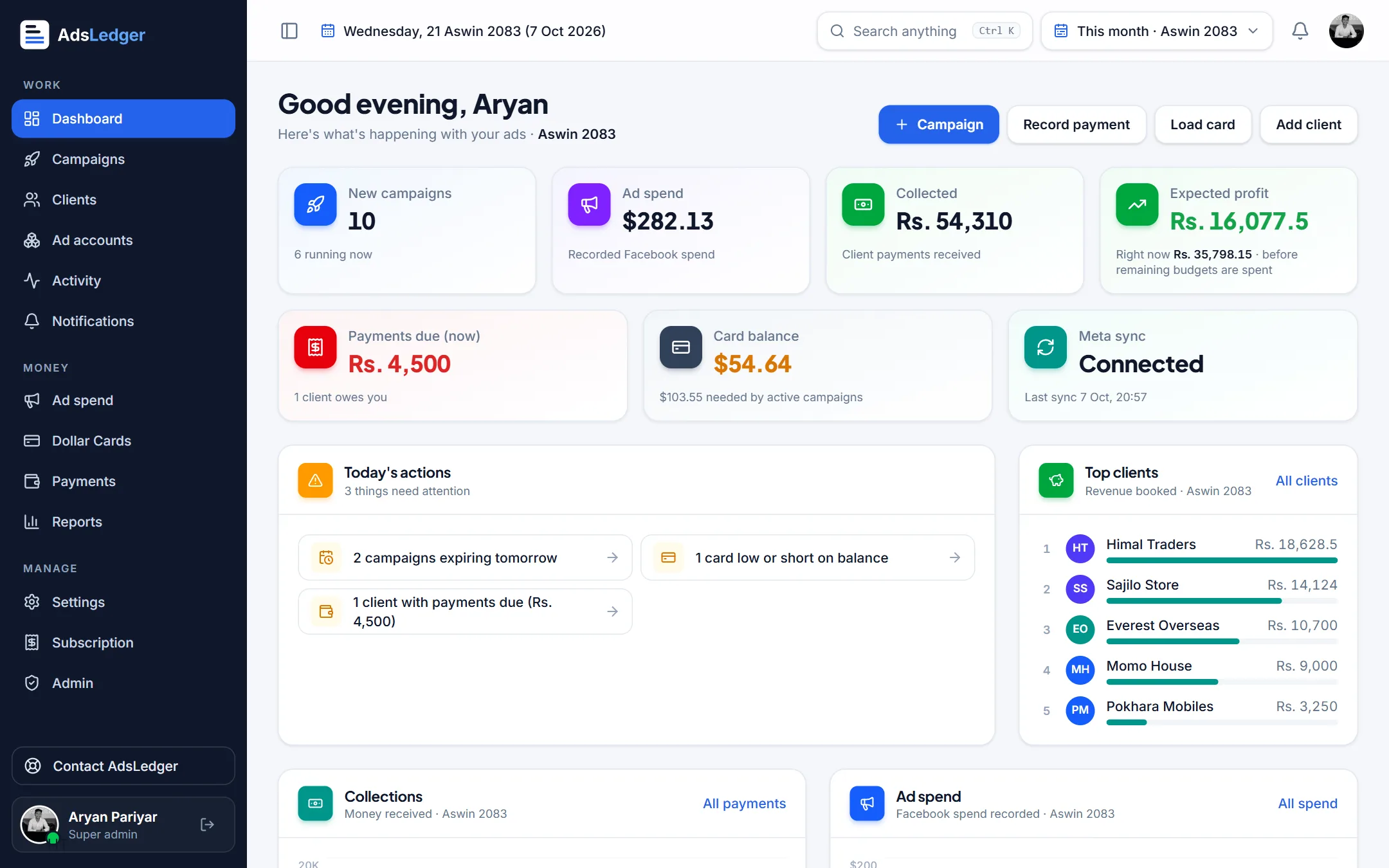
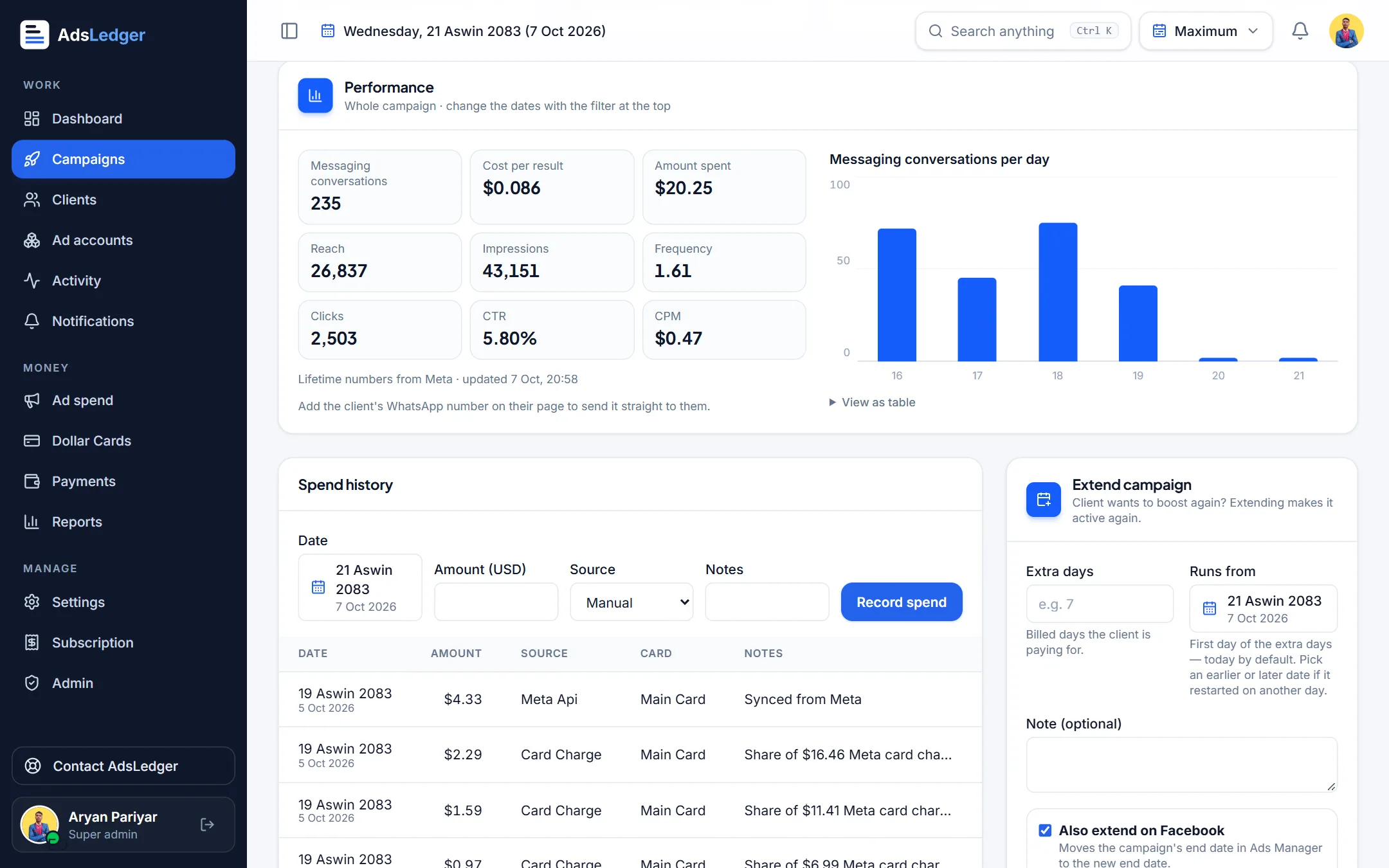
Boosting money moves in three directions: rupees into your dollar card, dollars out to Meta, and rupees in from clients, often in parts. Without records, it is easy to think you made money when a card fee, a currency move or an unpaid due wiped it out.
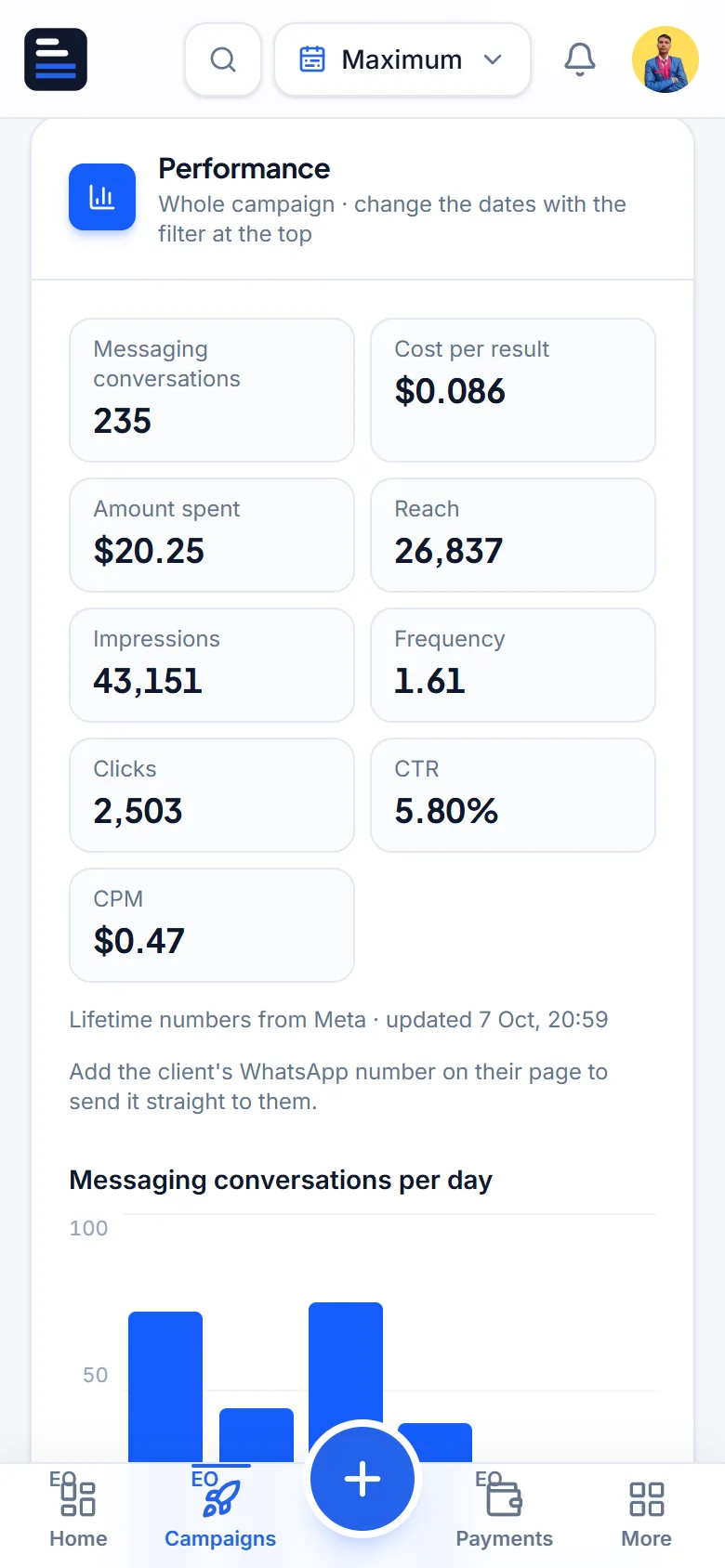
Track at least: each card load and its rupee cost, each campaign's budget, days and billing rate, actual spend, and each client payment. AdsLedger was built for exactly this workflow, from dollar cards to client dues. The getting started tutorial shows the setup in a few minutes.
- Money in: client payments, including partial payments and screenshots.
- Money out: card loads, software, design help, salaries.
- Profit: what you charged minus the real rupee cost of what was spent.
Common mistakes new operators make
- Pricing from a competitor's rate instead of your own cost rate.
- Starting campaigns before the client pays anything, then chasing dues for weeks.
- Running every client from one ad account, which mixes results and charges.
- Forgetting the yearly dollar card limit until it blocks a running campaign.
- Promising sales instead of promising a measurable result like messages.
Frequently asked questions
How much money do I need to start a Facebook boosting business in Nepal?
You need enough for a dollar card's issuance fee and a first load, often a few thousand rupees plus a small dollar balance. Many operators start by asking clients to pay before the campaign starts, so their own money is not tied up.
Is a dollar card limit enough for a boosting business?
The standard prepaid dollar card limit in Nepal is USD 500 per year. That covers a small number of clients. Some banks allow higher loads if you have foreign currency income, so ask your bank what applies to you.
Do I need a registered company to start?
Many operators start as freelancers. As you grow, registering a business, keeping invoices and understanding your tax position becomes important. Talk to a local accountant about what applies to you.
What should I charge my first clients?
Work out your real cost per dollar, then add a margin that covers your time and risk. Publicly advertised rates in 2026 are around Rs. 177–180 per dollar, which gives a reference point.
Sources
- Facebook Users in Nepal - NapoleonCat
- Nepali banks can issue prepaid dollar cards now: here are basics you need to know - Onlinekhabar
- Laxmi Sunrise Dollar Prepaid Card
- Boost Facebook Posts Easily in Nepal with Dollar Card - Global IME Bank
- Facebook Boost in Nepal - Prime IT Sewa
- Social Media Boosting in Nepal - Plus Point Solution
- The value of the US dollar has remained stable for a week straight - Ekantipur
- Boosted posts vs. ads - Hootsuite
- NRB's Notice on Issuance of Prepaid Cards for Payment in Foreign Exchange - Pradhan & Associates
Fees, limits and rules change — always confirm with your bank, Meta or the Inland Revenue Department. Examples are illustrations, not quotes.