How to Set Your Dollar Rate (NPR per USD) for Ad Clients
By Aryan Pariyar7 min read
Quick answer
Set your client dollar rate in two steps: first calculate your cost rate, the rupees one dollar on your card really cost you including fees, then add a margin that covers card charges, currency moves and your time. Publicly advertised rates in Nepal in 2026 are around Rs. 177–180 per USD against an NRB rate near Rs. 152–153. Review the rate every time you load your card.
Dollar rate for Facebook ads Nepal: the one-line answer
Your dollar rate for facebook ads nepal clients pay should be your real cost per dollar plus a margin, not the NRB rate and not a copy of a competitor's poster. Two numbers matter: the cost rate (what one dollar cost you) and the billing rate (what you charge the client per dollar).
Get the cost rate right and the billing rate becomes a simple business decision. Get it wrong and every campaign can look profitable while you slowly lose money.
Step 1: Know the reference rate
Nepal Rastra Bank publishes buying and selling rates every day. In August 2026, the NRB selling rate for one US dollar was about Rs. 152.84. Banks then apply their own selling rate when you load a dollar card, which can be a little different from NRB's.
The NRB rate is useful as a reference to explain prices to clients and to notice when the rupee moves. It is not your cost.
If a client questions your rate, the NRB rate is also a useful way to explain the gap: it shows them the base, and your margin covers card fees, setup work and risk.
Step 2: Calculate your real cost rate
Your cost rate includes everything you paid in rupees to get dollars onto the card and spend them on Meta. Card fees are set by each bank. Global IME Bank, for example, lists NPR 500 to issue a virtual card, NPR 100 per branch top-up (free through mobile banking) and NPR 300 renewal. Your bank may also charge a foreign transaction or cross-currency fee. Check your bank's schedule of charges.
If you load several times at different rates, you can either use the rate of the most recent load or a weighted average. The weighted average is more accurate: add up the rupees for all loads still on the card and divide by the total dollars. Whichever you choose, use the same method every time so that profit figures stay comparable from month to month.
- Write down the rupees debited from your account for the load.
- Add any top-up or service fee charged for that load.
- Divide the total by the dollars credited to the card.
- If your card charges a percentage fee on each Meta payment, note it separately as a card fee %.
Step 3: Look at what the market charges
Public price lists give a sense of what clients are used to seeing. When we checked in October 2026:
- Prime IT Sewa listed a boosting dollar charge of Rs. 177.
- Plus Point Solution listed Rs. 180 per dollar with a $2 minimum.
- AD Boosting in Nepal said on its Facebook page it charges a flat 20% service charge.
- The ACT360 Ads Manager app shows a breakdown of TDS 15%, bank charge 3.5%, service charge 15% and VAT 13% on top of ad spend, and still displays a fixed rate of NRs. 104 per USD on its FAQ, which looks out of date against the current NRB rate.
Step 4: Choose a margin you can defend
Your margin per dollar pays for your time, design work, the risk of the rupee moving before your next load, unpaid dues and refunds. A margin that looks big per dollar can be small once you count the hours spent on one client.
There are two simple ways to set it:
You can also charge different rates to different clients. A regular client who pays on time and needs no design work can get a slightly lower rate than a one-off client who wants three poster revisions. Just record which rate each client is on.
- Fixed rupees per dollar: billing rate = cost rate + Rs. X. Easy to quote, but your percentage margin shrinks when the rupee weakens.
- Percentage markup: billing rate = cost rate x (1 + margin %). Keeps your margin steady as costs move.
Step 5: Decide when the rate changes
Clients dislike surprise price changes, but you cannot keep an old rate when your cost goes up. Agree on a simple rule and tell clients upfront.
Good rules include: the rate is fixed for each campaign once it is paid; the rate is reviewed at each card load; and long campaigns or extensions use the rate on the day of the extension.
Currency moves matter more than they look. If the rupee weakens by Rs. 2 per dollar and you keep the same billing rate, a client spending $300 a month costs you Rs. 600 more each month. That can be a big share of a small operator's margin, which is why reviewing the rate at each card load is a good habit.
- Round your rate to a clean number (for example Rs. 178, not Rs. 177.63).
- Show clients the formula on request: budget x days x rate.
- Keep old campaigns at the rate they were sold at, so your records match what the client paid.
Store both rates, not just one
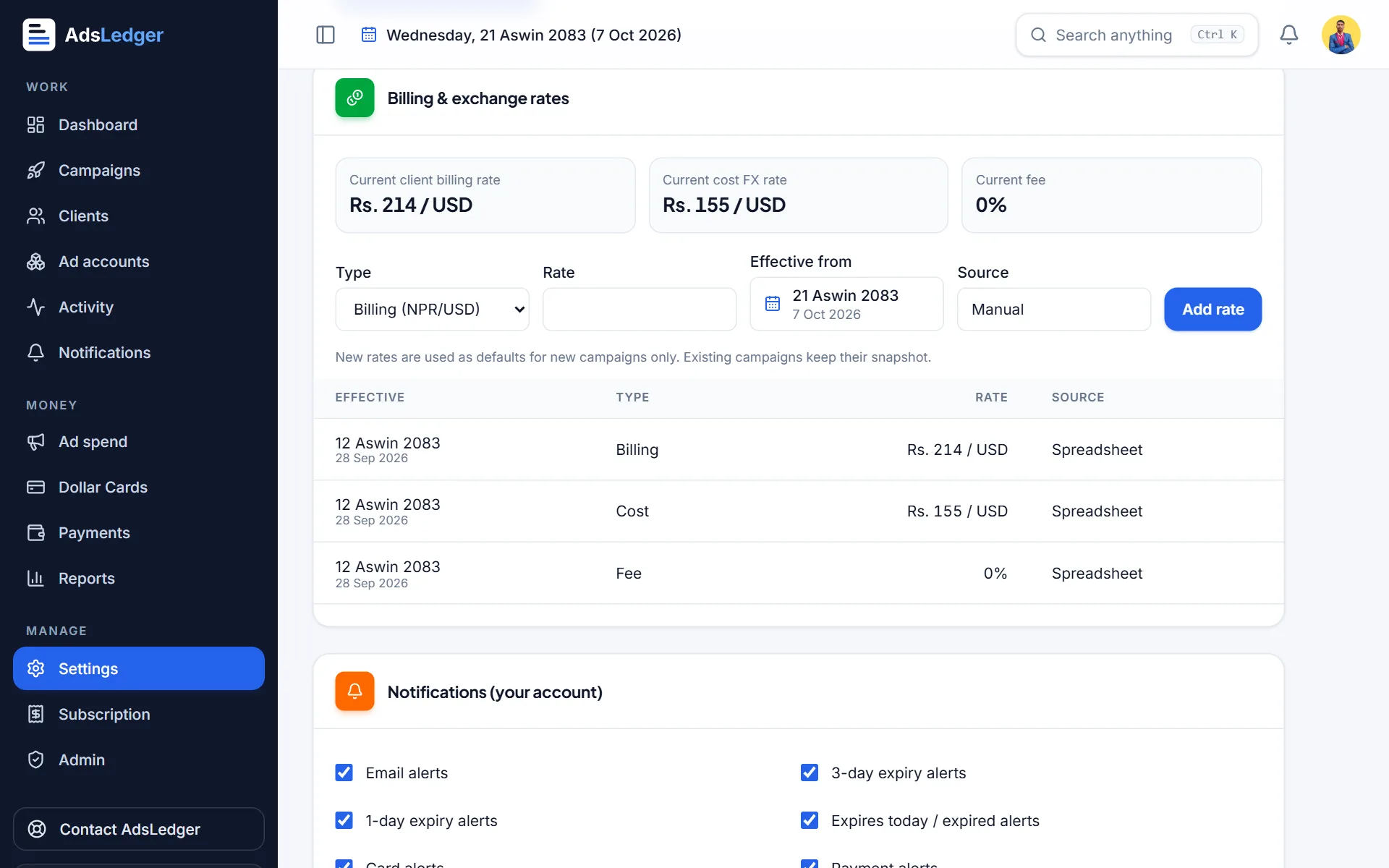
Profit is the gap between what you billed and what the dollars really cost, so you need both rates saved against each campaign. If you only remember the billing rate, you cannot tell which clients actually make you money.
In AdsLedger you set a default cost rate and billing rate, and each campaign keeps the rates it was created with, so later changes do not rewrite old profit. The set exchange rates tutorial walks through it.
Frequently asked questions
What dollar rate should I charge for Facebook ads in Nepal?
Start from your real cost per dollar including bank fees, then add a margin. Publicly advertised rates in 2026 are around Rs. 177–180 per USD, but your own cost rate decides what is profitable for you.
Should I use the NRB rate for my clients?
Use the NRB rate as a reference only. Your bank's card load rate and fees are your real cost, and you also need a margin for your time and risk.
How often should I change my dollar rate?
Review it whenever you load your card or the NRB rate moves noticeably. Keep the rate fixed for a campaign once the client has paid, so there are no surprises.
Is a percentage markup better than a fixed amount per dollar?
A percentage markup keeps your margin steady when the rupee moves. A fixed amount per dollar is easier to quote. Many operators use a percentage internally and round to a clean rupee number for clients.
Sources
- Foreign Exchange Rates - Nepal Rastra Bank
- The value of the US dollar has remained stable for a week straight - Ekantipur
- Boost Facebook Posts Easily in Nepal with Dollar Card - Global IME Bank
- Facebook Boost in Nepal - Prime IT Sewa
- Social Media Boosting in Nepal - Plus Point Solution
- AD Boosting in Nepal (Facebook Page)
- FAQs - ACT360 Ads Manager
Fees, limits and rules change — always confirm with your bank, Meta or the Inland Revenue Department. Examples are illustrations, not quotes.